C64 Sound Lab
Play classic sound effects, compose on the SID piano and build beats on the drum machine
C64 Sound Lab: hear the SID chip in your browser
The Commodore 64 was famous for its sound. The SID chip gave it a voice unlike anything else in home computing. This Sound Lab lets you explore that sound directly in your browser.
Three tools, one page. The sound effects generator plays twelve classic C64 arcade sounds at the press of a button. The SID piano lets you play notes across two octaves, with real SID frequency register values shown for every key you press. The drum machine gives you a 16-step sequencer with kick, snare, hihat, tom and clap.
Everything is generated using the Web Audio API. There are no samples, no external libraries and nothing to install. The sounds are approximations of the SID chip, built from oscillators, noise buffers and gain envelopes, the same building blocks the SID itself used.
Sound requires a click to start. Browsers block audio until the user interacts with the page.
Shop on Amazon
Find Commodore hardware, games, books and accessories. Browse the full range on Amazon.
Classic C64 sound effects
These twelve sounds cover the core vocabulary of classic C64 arcade games. Laser shots, explosions, jumps, coins, game over stings and power-up chimes were built from the same oscillator and noise routines every C64 programmer had access to.
On a real C64, programmers would write directly to the SID registers in memory. A single POKE command could trigger an oscillator, set its frequency and shape its volume over time. The sounds here are recreated using the same principles in the Web Audio API.
Each effect uses a short envelope, typically a fast attack and decay with no sustain or release. This is the same pattern the SID chip used for one-shot game sounds, where the note needed to start and finish within a fraction of a second without any clicks or pops.
Learn how the SID chip works ▶SID piano with real frequency values
Click any key or use your computer keyboard to play notes. The display below the keyboard shows the note name, its frequency in hertz, and the 16-bit SID register value you would use on a real C64.
The SID chip does not understand musical notes directly. To play A at 440 Hz, you write a calculated register value to memory address 54272 (low byte) and 54273 (high byte). The formula is based on the PAL clock speed of 985,248 Hz. The piano displays both values and shows the corresponding POKE commands.
Three waveforms are available: sawtooth, triangle and square. Each gives a distinctly different tone. Sawtooth is bright and cutting, triangle is soft and mellow, and square has a hollow woody quality. These are three of the four waveforms the real SID chip offered.
The keyboard supports polyphony, so you can hold several keys at once. The SID chip itself had three independent voices, each capable of playing a different note simultaneously.
Listen to real SID music ▶16-step drum machine
Click the step buttons to build a pattern across five drum channels, set your tempo and press Play. Load the 4/4 or Shuffle presets to start with a ready-made rhythm, or clear the grid and build your own from scratch. The Export button generates BASIC DATA lines you could type into a real C64.
How C64 programmers made sound
The SID chip at address $D400 had 29 registers that controlled three independent voices. Each voice had its own oscillator, waveform selector, envelope generator and filter routing. A programmer could write directly to these registers from BASIC using POKE, or from 6510 assembly for full control.
Sound effects in games were typically short routines that wrote a sequence of values to the SID registers on each video frame, 50 times per second on PAL. A laser shot might sweep the frequency register from high to low over eight frames, producing the characteristic descending tone.
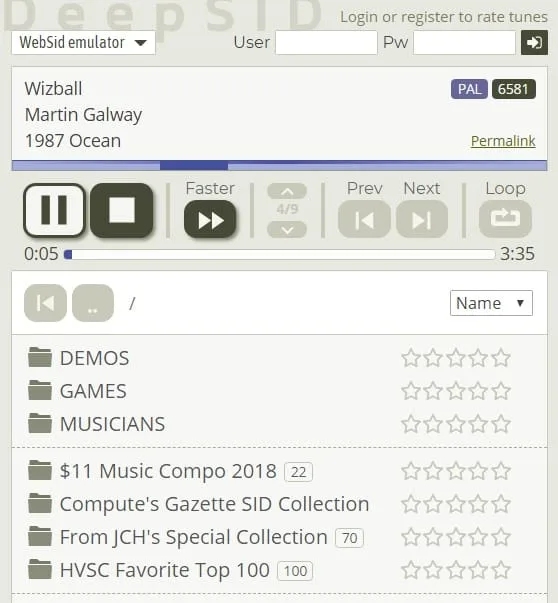
Music was more complex. Composers like Rob Hubbard and Martin Galway wrote intricate multi-voice tunes in assembly, carefully timing register writes to create arpeggios, vibrato, portamento and ring modulation effects that pushed the chip well beyond its specifications.
Rob Hubbard, SID composer ▶The SID chip legacy
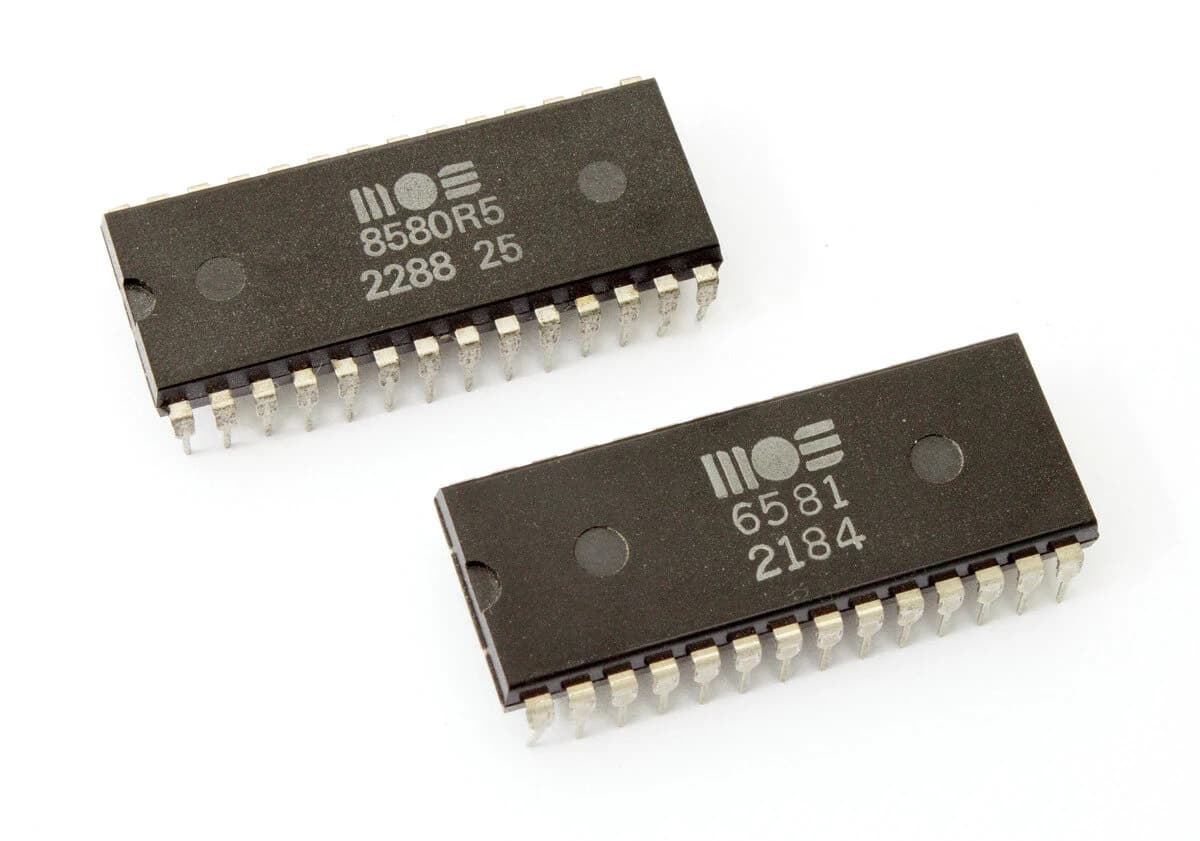
The MOS Technology 6581 and 8580 SID chips were designed by Bob Yannes, who went on to co-found the synthesiser company Ensoniq. The SID was essentially a three-voice analogue synthesiser on a single chip, an extraordinary capability for a mass-market home computer in 1982.
Today the SID chip has a dedicated following among musicians and hardware enthusiasts. Original chips are still used in custom synthesisers and sound cards. The High Voltage SID Collection contains over 50,000 tunes composed for the C64, and active demoscene communities continue to produce new music for the chip more than forty years after its introduction.
The sounds you hear in this Sound Lab are pale approximations of what the real chip could do. The Web Audio API lacks the analogue filter characteristics, the slight tuning drift and the raw grit that made the SID so distinctive. But the fundamentals are the same: oscillators, noise, envelopes and a bit of imagination.
The SID chip explained ▶**** FREQUENTLY ASKED QUESTIONS ****
READY.
Discover the SID chip
The sounds in this lab are built on the same principles as the real SID chip. Learn how MOS Technology designed the chip that gave the C64 its voice and why it is still celebrated by musicians today.
The SID Chip ▶