Commodore 64 Capabilities
What the C64's three custom chips could do, and what programmers made them do
Commodore 64 Capabilities: Hardware Ahead of Its Time
Three custom chips. A price point at which they had no right to exist. And what programmers made of them.
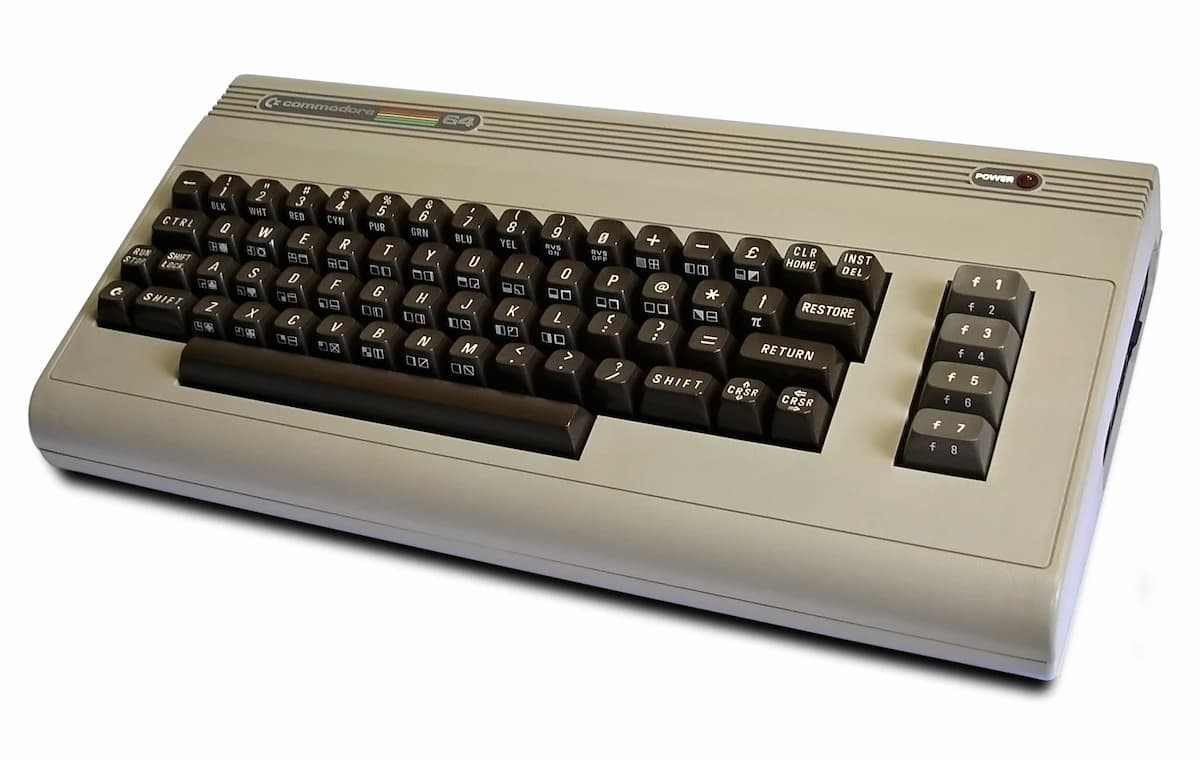
In 1982, most home computers were built around a single general-purpose chip and whatever basic circuitry the manufacturer could afford to add. The Commodore 64, priced at $595 at launch and quickly falling well below $200, took a different approach. Three custom chips sat at the heart of the machine: the MOS 6510 processor, the VIC-II graphics chip, and the SID sound chip. Together, they gave the C64 capabilities that competitors scrambled to match for years.
The 6510 ran at just under 1 MHz, a figure that sounds modest today but was competitive in 1982. More important than the clock speed was what sat alongside it. The VIC-II handled graphics independently of the CPU, freeing the processor to run game logic while sprites moved across the screen without any processor involvement at all. The SID chip produced three independent synthesised voices simultaneously. No home computer at any similar price came close to this combination.
Shop on Amazon
Find Commodore hardware, games, books and accessories. Browse the full range on Amazon.
Interactive Memory Map
All 64 KB of the C64 address space, from $0000 to $FFFF. Click any region to see what lives there.
The C64 VIC-II Chip: 8 Sprites and a Raster You Could Control
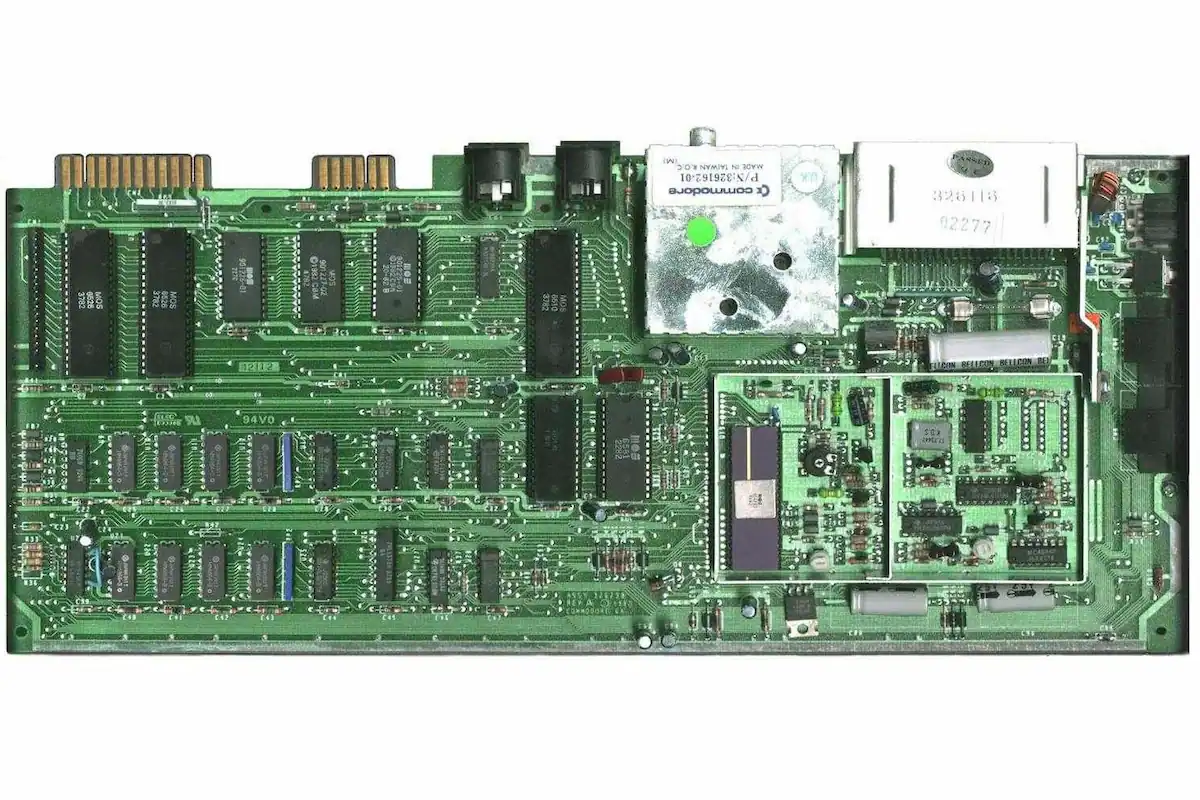
The Video Interface Chip II (MOS 6569 in PAL regions, 6567 in NTSC) gave the C64 graphical capabilities that required genuine skill to fully exploit. Its basic output was a 320x200 pixel screen in high-resolution mode, or 160x200 in multicolour mode where each pixel could be one of four colours rather than two. A fixed palette of 16 colours was available throughout. What separated the C64 from its contemporaries was not the resolution or the colour count, but what the chip could do with those resources.
Eight hardware sprites were the VIC-II's most significant feature for game developers. Each sprite was a 24x21 pixel object that could be independently positioned anywhere on screen, assigned its own colour, scaled to double size, and checked for hardware collisions with other sprites or the background. The CPU moved sprites by writing to a handful of memory-mapped registers. Because sprites were hardware objects, animating and positioning eight of them simultaneously cost no CPU cycles for drawing.
What really separated skilled C64 programmers from the rest was mastery of the raster interrupt system. The VIC-II could trigger a CPU interrupt at any specified horizontal raster line, allowing code to run at a precise moment in the display frame. Colour registers could be changed mid-screen, producing gradient effects and colour splits impossible in a single static frame. Programmers used this technique to display more colours than the hardware officially supported and to create the characteristic colour bars that became a signature of C64 demo culture. Combined with hardware scrolling in both horizontal and vertical directions, the VIC-II rewarded deep knowledge with effects that made other machines look flat by comparison.
Commodore 64 Capabilities: Technical Specifications
| CPU | MOS 6510 @ 0.985 MHz (PAL) / 1.023 MHz (NTSC) |
| RAM | 64 KB (bank-switched with ROM overlays) |
| ROM | 20 KB (BASIC v2, KERNAL, Character ROM) |
| Graphics chip | MOS 6569 VIC-II (PAL) / 6567 (NTSC) |
| Display modes | 320x200 hires / 160x200 multicolour |
| Colours | 16 fixed colours; more via raster tricks |
| Hardware sprites | 8 (24x21 px, independently positionable) |
| Sound chip | MOS 6581 / 8580 SID |
| SID voices | 3 independent oscillators |
| SID waveforms | Triangle, Sawtooth, Pulse, Noise |
| SID filter | Lowpass, Highpass, Bandpass with resonance |
| SID extras | Ring modulation, oscillator sync, ADSR per voice |
Commodore 64 Audio Capabilities: The SID Chip
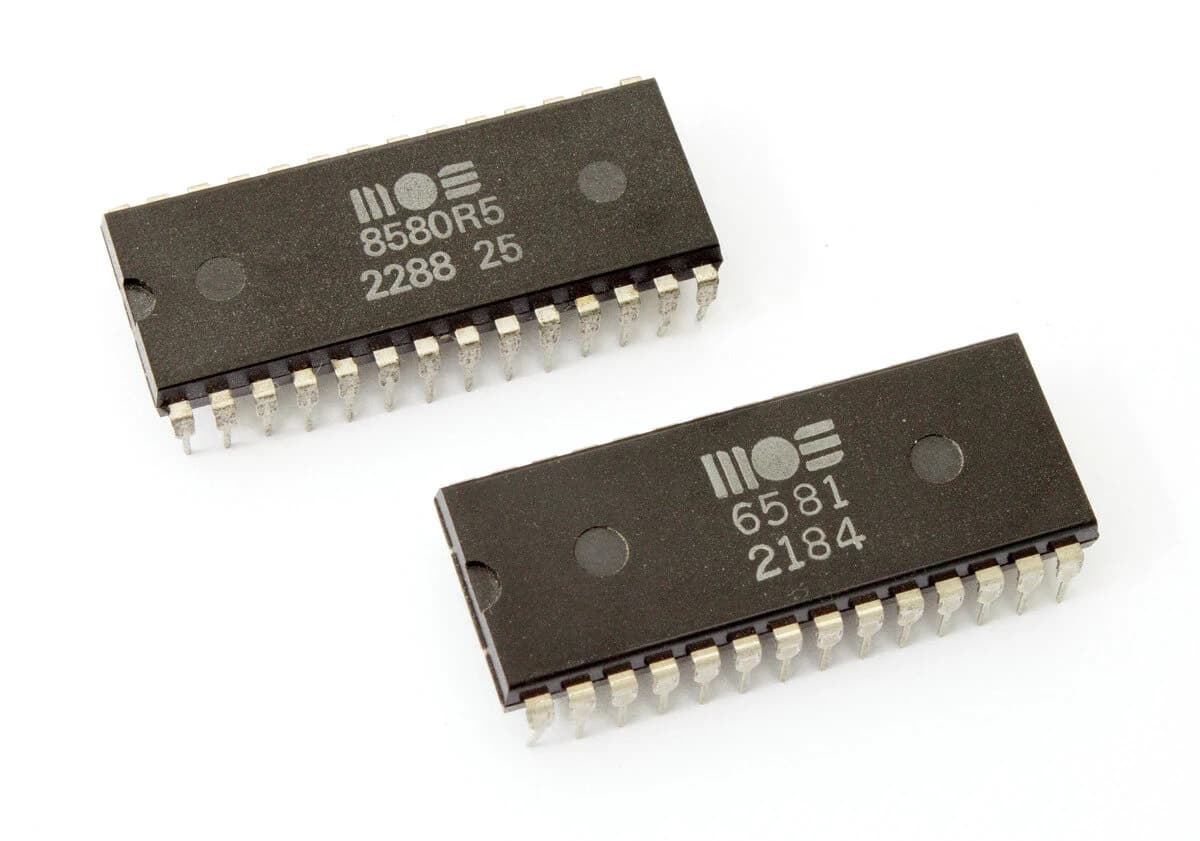
The MOS 6581 SID chip (Sound Interface Device) was not a sound effects generator or a tone beeper. It was a complete three-voice synthesiser with analogue circuitry, programmable filters, and the expressive range of a hardware instrument. Each of the three voices could produce four waveforms independently: triangle (smooth and warm), sawtooth (bright and buzzy), pulse (whose timbre changed with the pulse width, from hollow to nasal), and noise (for percussion and atmospheric effects). Each voice had its own ADSR envelope (Attack, Decay, Sustain, Release), giving composers precise control over how each note grew, peaked, and faded.
The filter was the SID's most distinctive feature. A single resonant filter, applicable to any combination of voices, could be configured as lowpass (cutting high frequencies for warmth), highpass (cutting lows for presence), or bandpass (passing a narrow range for telephone and nasal effects). The cutoff frequency and resonance were fully programmable, meaning composers could sweep the filter in real time for wah effects, drive the resonance high for screaming lead sounds, or shape percussion into something that felt physical.
Two additional features pushed the SID further still. Ring modulation between oscillators produced metallic and bell-like tones that no single oscillator could generate alone. Oscillator synchronisation locked two voices together, creating complex waveforms for aggressive leads and bass sounds. Because the SID was an analogue design, the 6581 and 8580 chips sounded subtly different from each other: the 6581 had a slight filter distortion characteristic that composers worked into their arrangements. That analogue imprecision became a defining part of the C64's voice, the reason SID music sounds like nothing else.
C64 BASIC, PEEK and POKE: What Programmers Could Do
The Commodore 64 came with BASIC v2 in ROM, and typing RUN was enough to begin. For a beginner in 1982, the BASIC prompt was an invitation. Two commands became essential quickly: PEEK and POKE. PEEK read a value from any memory address. POKE wrote one. Because the C64's hardware registers for the VIC-II, SID, and CIA chips all appeared as ordinary memory addresses, PEEK and POKE gave BASIC programmers direct control over the graphics chip, the sound chip, and everything else. POKE 53280,0 set the screen border to black. Hardware that required assembly language on other machines was accessible from BASIC on the C64.
Assembly language opened the machine fully. A skilled 6510 programmer could write code that ran roughly a hundred times faster than equivalent BASIC. Memory bank switching allowed different combinations of RAM and ROM to be overlaid across the 64KB address space, giving access to more memory than the chip nominally addressed. The zero page (the first 256 bytes of RAM) could be accessed with shorter, faster instructions than the rest of memory, and experienced programmers kept frequently-used variables there as standard practice.
The demoscene documented what the C64 was truly capable of. Programmers discovered that careful raster interrupt timing could stretch the display area beyond its designed boundaries. Sprite multiplexing routines repositioned the eight hardware sprites multiple times per frame, displaying dozens of simultaneously moving objects on screen well beyond the official limit. Techniques for playing digitised audio samples through the SID were found and refined. Every limit the hardware imposed was eventually worked around. The C64 was a machine that rewarded the programmers who understood it deeply, and the depth of that understanding grew for decades after the machine stopped being manufactured.
**** FREQUENTLY ASKED QUESTIONS ****
READY.
Explore the Commodore 64
Discover all C64 models, the history, and the legendary SID chip.